




How to build a teacher training plan: seven steps and a template
A teacher training plan is not a course calendar: it is the institution’s answer to a specific question — what do our teachers need to learn this year so our students learn better — and the way to check it happened. These are the steps we follow with schools and universities.
Published September 22, 2026 · Geedle Team
What is a teacher training plan?
It is the document that organizes, for a school year, the professional development activities of the teaching staff: what will be learned, by whom, when, in which format, with what resources, and how the result will be measured. It starts from a needs assessment and ends with an evaluation of impact on practice.
The seven steps
- Identify real needs. Survey the faculty, review learning results, and observe classes. Ask what they struggle with, not which course they want: the answer changes.
- Prioritize three strands at most. For example, formative assessment, artificial intelligence, and school climate. Ten topics in a year equal none.
- Write observable objectives. “Every teacher applies an analytic rubric in at least two projects this term” can be checked; “improve assessment” cannot.
- Design paths by profile. A new teacher, a veteran, and a coordinator do not need the same thing. Short paths by level avoid boring some and losing others.
- Schedule around the workload. Avoid grading periods and exam seasons. Weekly microlessons beat marathon sessions.
- Plan follow-up and incentives. Reminders, alerts to coordinators, team challenges, micro-credentials, and public recognition keep participation up.
- Evaluate impact. Measure classroom application and, where possible, changes in learning, not just attendance and satisfaction.
Minimum plan template
| Element | What to write | Example |
|---|---|---|
| Strand | Prioritized need | Formative assessment |
| Objective | Observable classroom behavior | Apply analytic rubrics in two projects |
| Participants | Profile and number | 42 elementary and middle school teachers |
| Format | Online, live, in-person, or blended | Microlessons + two in-person workshops |
| Calendar | Weeks and hours | September to November, 2 h per week |
| Follow-up | Who reviews and how often | Coordinator, biweekly report |
| Incentives | How progress is recognized | Micro-credential and mention at the staff meeting |
| Impact indicator | How it is verified | Rubrics applied and peer-reviewed |
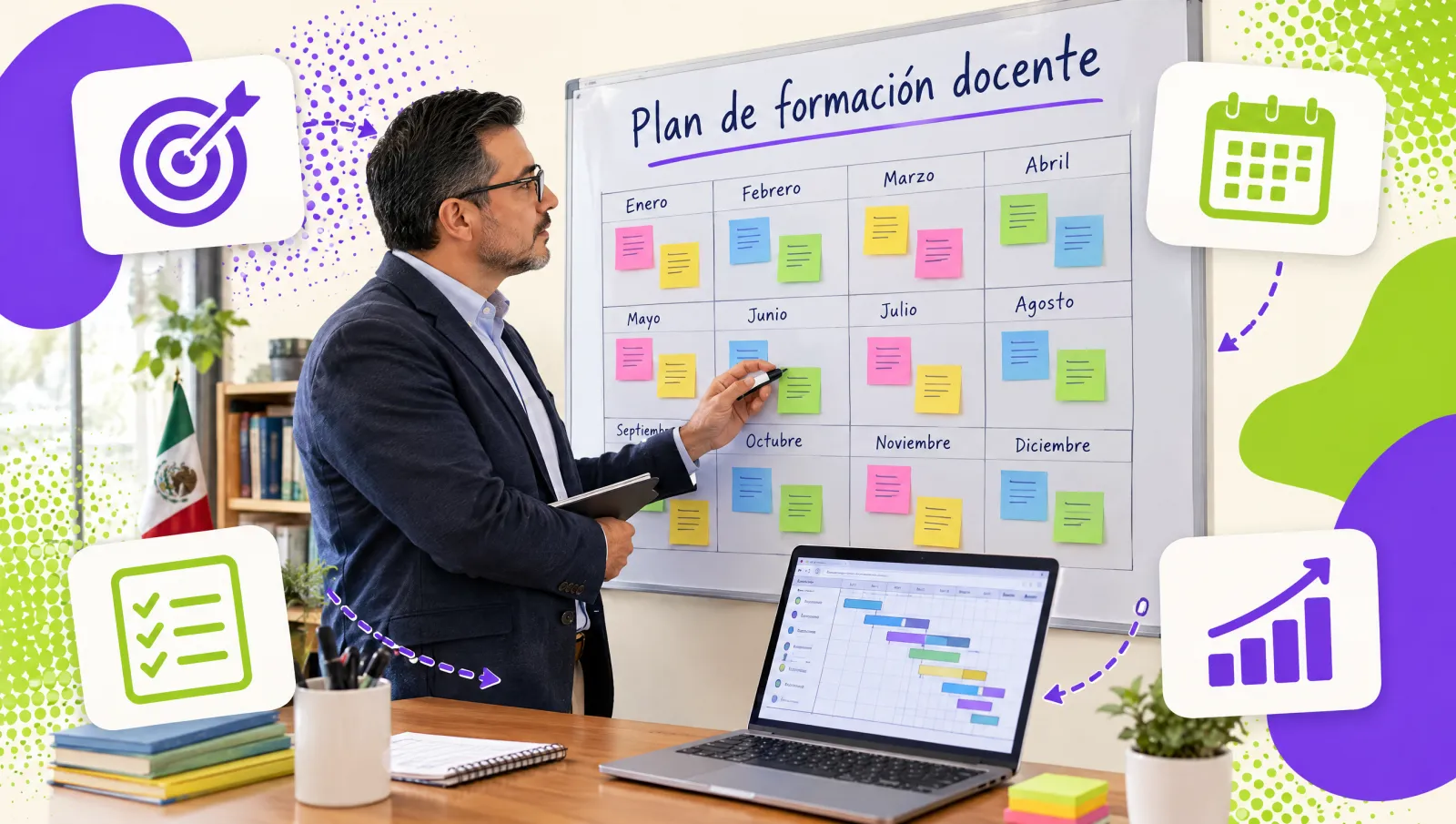
Sample annual calendar
| Period | Action | For whom |
|---|---|---|
| August | Needs assessment and onboarding for new hires | Whole faculty / new teachers |
| September to November | Path 1: formative assessment (microlessons + 2 workshops) | Whole faculty |
| December | Break for end of term; recognition for the first block | Whole faculty |
| January to March | Path 2: artificial intelligence in class, by skill level | Whole faculty |
| April | Mid-year review and plan adjustments | Leadership and coordinators |
| May and June | Learning communities: presenting evidence | Departments |
| July | Impact evaluation and next year’s plan | Leadership and coordinators |
The calendar varies with each institution’s level and school calendar, but the logic holds: few paths, well spaced, with breaks at the end of each term and an explicit moment to review and adjust.
Common mistakes
- Choosing courses from a catalog before doing the needs assessment.
- Packing all training into the week before classes start.
- Measuring only attendance and satisfaction.
- Leaving no time to practice with a class or share results with peers.
- Forgetting onboarding for teachers who join mid-year.
If you want help to assess, design, and run the plan — with a gamified platform, follow-up, incentives, and an AI agent that supports the faculty — see our teacher training and professional development programs. We work across Mexico, with in-person support in cities such as León, Querétaro, and Puebla. For the concepts, read teacher education vs. teacher training.