




Teacher education vs. teacher training: how they differ and why you need both
The two terms get used interchangeably in calls for proposals, school plans, and even laws, but they are not the same. Understanding the difference helps principals and coordinators decide what their faculty needs, and avoid spending the budget on courses that change nothing in the classroom.
Published September 22, 2026 · Geedle Team
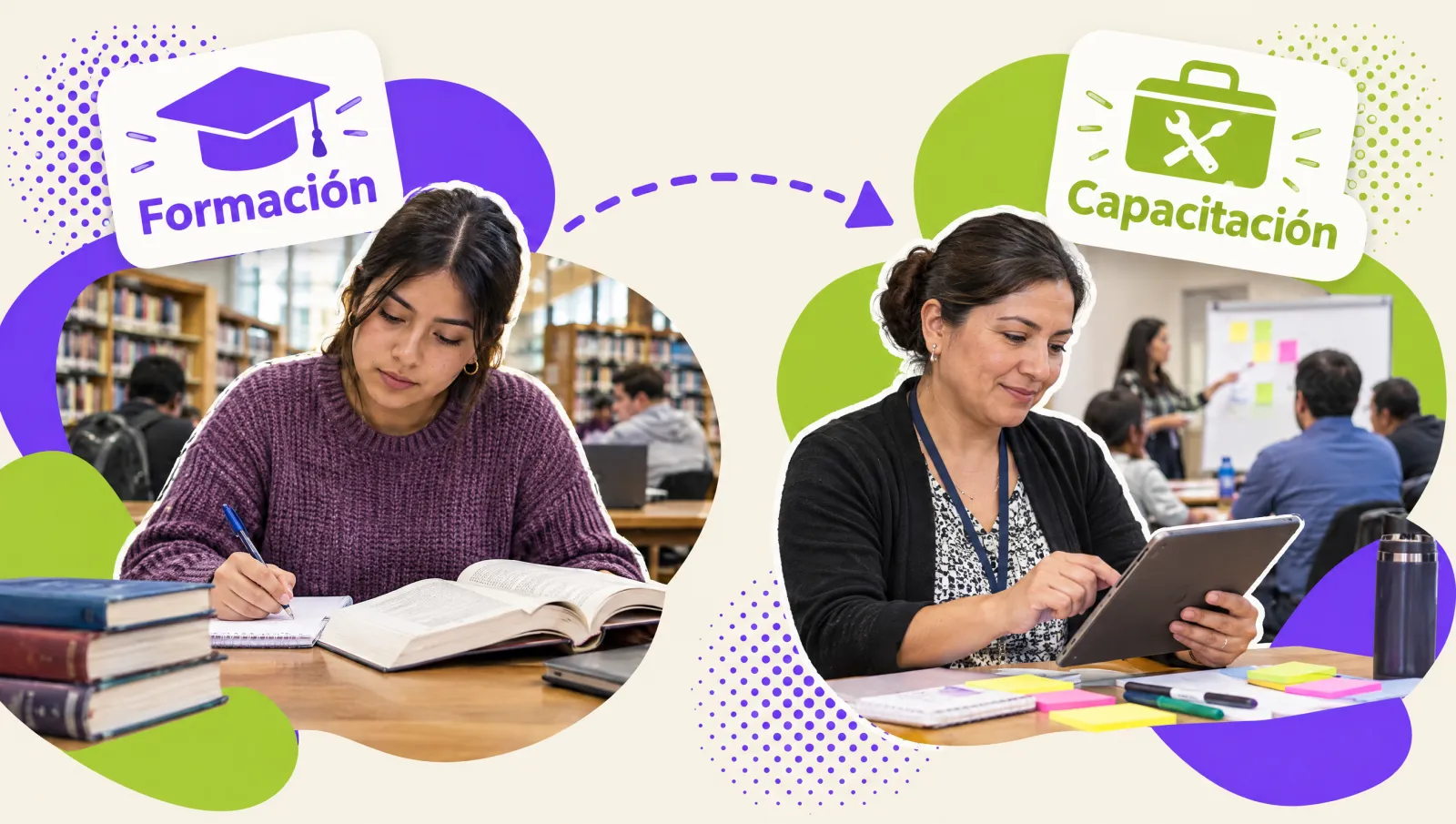
What is the difference between teacher education and teacher training?
Teacher education is the broad, long-term process through which someone becomes a teaching professional: it combines pedagogical, subject, and ethical knowledge with professional identity and reflection on practice. Teacher training is narrower and shorter: it builds or updates a specific skill — a teaching method, a tool, an assessment model — to be applied in class soon. Education answers “what kind of teacher do I want to be”; training answers “what do I need to master this year”.
The differences side by side
| Criterion | Teacher education | Teacher training |
|---|---|---|
| Scope | Comprehensive: knowing, doing, being | Specific: one skill or tool |
| Length | Long term, the whole career | Short: hours or weeks |
| When | Initial (teacher colleges, universities) and continuing | On the job, as needs arise |
| Goal | Build professional identity and judgment | Solve a concrete classroom need |
| Examples | Education degree, master’s, long diploma program | Formative assessment course, AI workshop, onboarding |
| Evidence | Degrees, career path, reflective practice | Classroom application, certificates, micro-credentials |
Initial and continuing teacher education
In Mexico, initial teacher education takes place at teacher colleges (escuelas normales), the National Pedagogical University, and schools of education: it is the degree that qualifies someone to teach. Continuing education starts on the first day in front of a class and never ends: courses, workshops, diploma programs, learning communities, and coaching. Teacher training lives inside continuing education; it is its most agile, hands-on part.
Why a good program combines both
- Training alone produces teachers with many certificates and little judgment: they know how to use the trendy tool, but not when it makes sense.
- Education alone produces valuable reflection that is slow to reach the classroom: the teacher understands the model but has no time to translate it into Monday’s lesson.
- Together, education provides the framework and training provides the resources: the teacher knows why and knows how.
How to decide what your faculty needs
Before choosing a course, answer four questions. The answers show whether the problem calls for education (judgment, framework, identity) or training (a specific missing skill).
- Does the problem show up in every class or only with one tool? If it is general — for example, assessing only with tests — you need education. If it is specific — teachers cannot use the platform — training is enough.
- Do teachers know why the change matters? If they do not share the why, any workshop stays superficial. The framework comes first.
- Is there time to practice with a real class? Without practice, neither education nor training reaches the classroom. Set aside hours to apply and get feedback.
- How will you verify the change? Define the evidence from the start: an applied rubric, a peer-reviewed lesson plan, a classroom observation.
Examples by education level
| Level | Education example | Training example |
|---|---|---|
| Preschool and elementary | The New Mexican School approach and community projects | Early literacy workshop with hands-on materials |
| Middle school | Formative assessment as a school culture | Designing analytic rubrics for projects |
| High school | Tutoring and social-emotional support | Using artificial intelligence to give feedback on essays |
| University | Learner-centered teaching for adjunct faculty | Designing a hybrid course in the institutional LMS |
What it looks like in practice
An annual professional development program can have one education strand — say, assessment for learning — and several short trainings that bring it down to earth: rubric design, feedback with AI, evidence portfolios. Each training ends with something the teacher applies with their class, and the strand is worked through in learning communities where results are shared.
That is how we design our teacher training and professional development programs: short, hands-on, gamified paths with an AI agent that supports teachers between sessions. If you are building your school’s program, our guide on how to build a teacher training plan will help too.