




Continuing teacher education in Mexico’s New Mexican School: a guide for school leaders
The New Mexican School (Nueva Escuela Mexicana) changed not only the curriculum but the very idea of how in-service teachers develop: fewer isolated courses, more reflection on practice, collegial work, and coaching. This guide summarizes how it is organized and what schools can do to complement it.
Published September 22, 2026 · Geedle Team
What is continuing teacher education under the New Mexican School?
It is the ongoing professional development of in-service teachers, with a humanistic, situated, and collaborative approach. Instead of “filling gaps” with generic courses, it starts from the reality of each classroom and community, encourages reflection on one’s own practice, and relies on peer work. Teachers stop being recipients of training and become authors of their own development.
Who runs continuing teacher education in Mexico?
- The Ministry of Public Education (SEP), through its continuing education office for teachers and school leaders, sets the national strategy and course offering, in line with Article 3 of the Constitution.
- State education authorities run the strategy in all 32 states, adapt it to local conditions, and extend coverage, especially in vulnerable areas.
- Academic institutions such as the National Pedagogical University take part in designing and reviewing training programs.
- At the high school level, the corresponding undersecretariat runs its own training and update program, with a 2025–2030 strategy that moves from individual to collective development.
The official offering for public school teachers is free and published in windows throughout the year. It is the reference for any public school teacher.
Priority topics
| Topic | What it means in class |
|---|---|
| Analytical program co-design | Adapting the national curriculum to the school and community, collegially |
| Formative assessment | Giving feedback during the process, not just grading at the end |
| Socio-critical methods and projects | Community, classroom, and school projects |
| Interdisciplinary work | Integrating learning fields instead of isolated subjects |
| Reading, writing, and scientific thinking | Foundational skills for accessing knowledge |
| Cross-cutting themes | Human rights, gender equality, inclusion, and healthy living |
In needs assessments, teachers themselves point to co-design, formative assessment, socio-critical methods, and interdisciplinary work as the areas where they need more depth and more practical tools.
Learning communities: the heart of the model
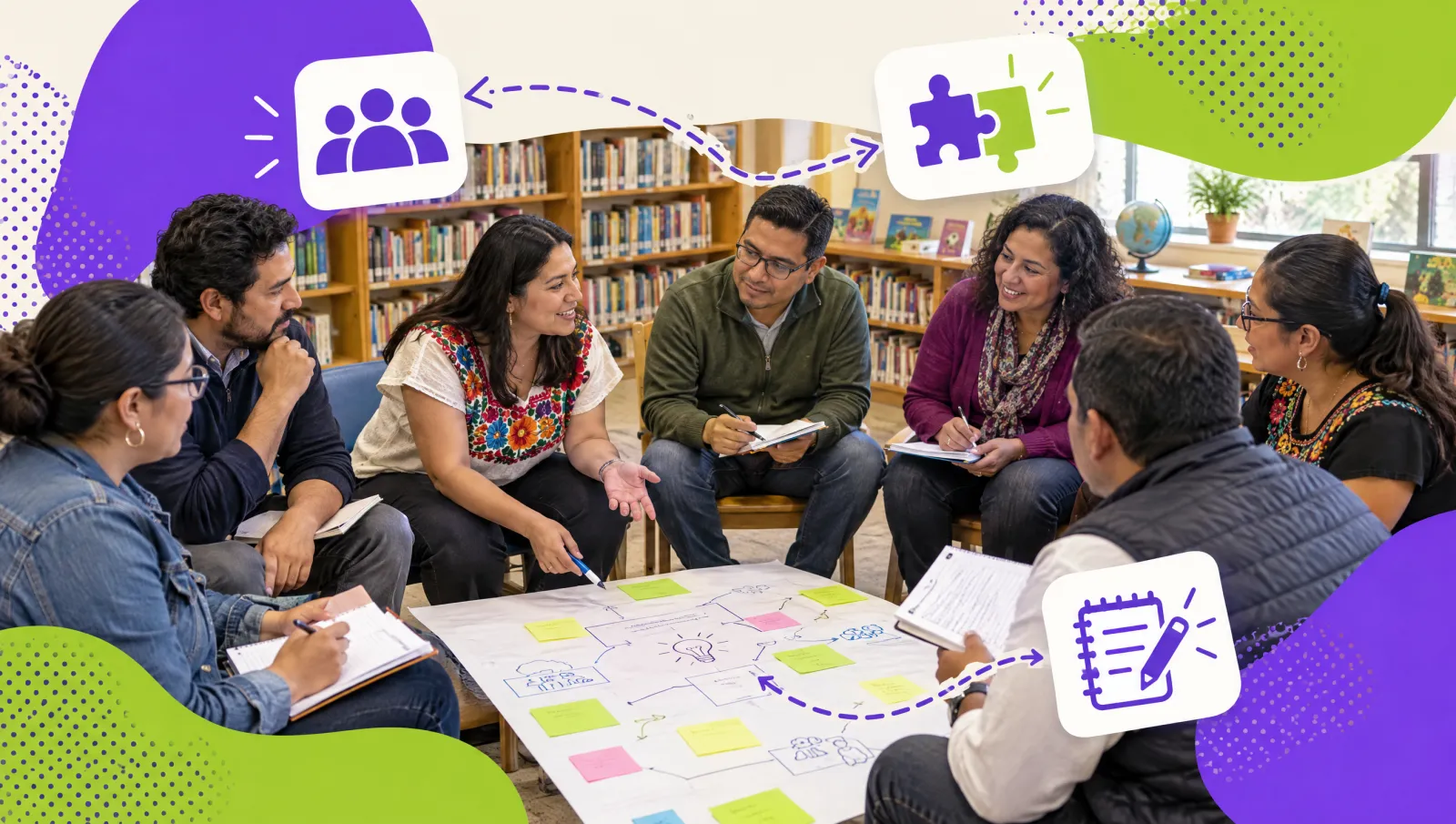
Training stops being top-down — an expert lecturing passive recipients — and becomes circular: teachers share experiences, compare methods, and design strategies together. Coaching changes too: supervisors no longer impose criteria but engage in dialogue as partners. For a school, this means setting aside real time for collegial work and giving it structure, not just a slot on the calendar.
Common mistakes when launching learning communities
- Turning the collegial session into an admin meeting. If the time goes to announcements, there is no room left to analyze practice.
- Showing up without classroom evidence. Without lesson plans, student work, or observation notes, the conversation stays at the level of opinion.
- Relying on one person. If only the coordinator drives the community, it fades when they move schools. Rotate facilitation.
- Not following up on agreements. Each session should end with a small, verifiable commitment for the next one.
What it means for private schools and universities
Private schools affiliated with the SEP use the official curriculum, so they also need to train their faculty in co-design, projects, and formative assessment, but on their own calendar, with their own identity and, often, bilingual or enrichment programs. In high schools and universities the challenge is usually different: subject experts who never had pedagogical training and who teach at several institutions. In both cases a short, hands-on path of their own works better than a generic catalog.
How schools can complement it
- Start from the official offering. If your staff works in public schools, check which official courses cover their needs before looking elsewhere.
- Run your own needs assessment. An urban middle school does not have the same needs as a rural elementary school or a bilingual private school.
- Give learning communities structure. Shared challenges, classroom evidence, and a space to show results keep peer work going.
- Support teachers between sessions. Questions come up on a Tuesday at 9 p.m., not on workshop day. An AI assistant trained on the program’s materials helps sustain the process.
- Recognize progress. Micro-credentials and incentives turn invisible effort into something worth celebrating.
Private schools and universities usually need their own program, aligned with their educational model. That is what we do in teacher training and professional development: hands-on, gamified paths that complement, not replace, official training. If you are getting started, also read how to build a teacher training plan.
This article summarizes the general approach of Mexico’s continuing education policy. For current calls, dates, and requirements, always check the official SEP and state education authority websites.