




Artificial intelligence for teachers: using it in class without losing your judgment
Your students already use artificial intelligence, whether you allow it or not. The useful question is not whether teachers should use it, but for what, within which limits, and how to train the whole faculty to use it with pedagogical intent. This guide collects what works in schools and universities in Mexico.
Published September 22, 2026 · Geedle Team
What is artificial intelligence useful for, as a teacher?
Saving time on preparation and personalizing learning, always with the teacher accountable for the result. The highest-impact uses are four: planning teaching sequences, creating and adapting materials, designing rubrics and giving feedback, and generating extra practice for those who need it. AI suggests; the teacher decides, corrects, and adds context.
Five concrete classroom uses
- Planning. Ask for a sequence for a specific learning goal, with your class’s context, and adjust it. Never use it as is: AI does not know your students.
- Differentiated materials. The same text at three reading levels, examples close to the community, questions of varying complexity.
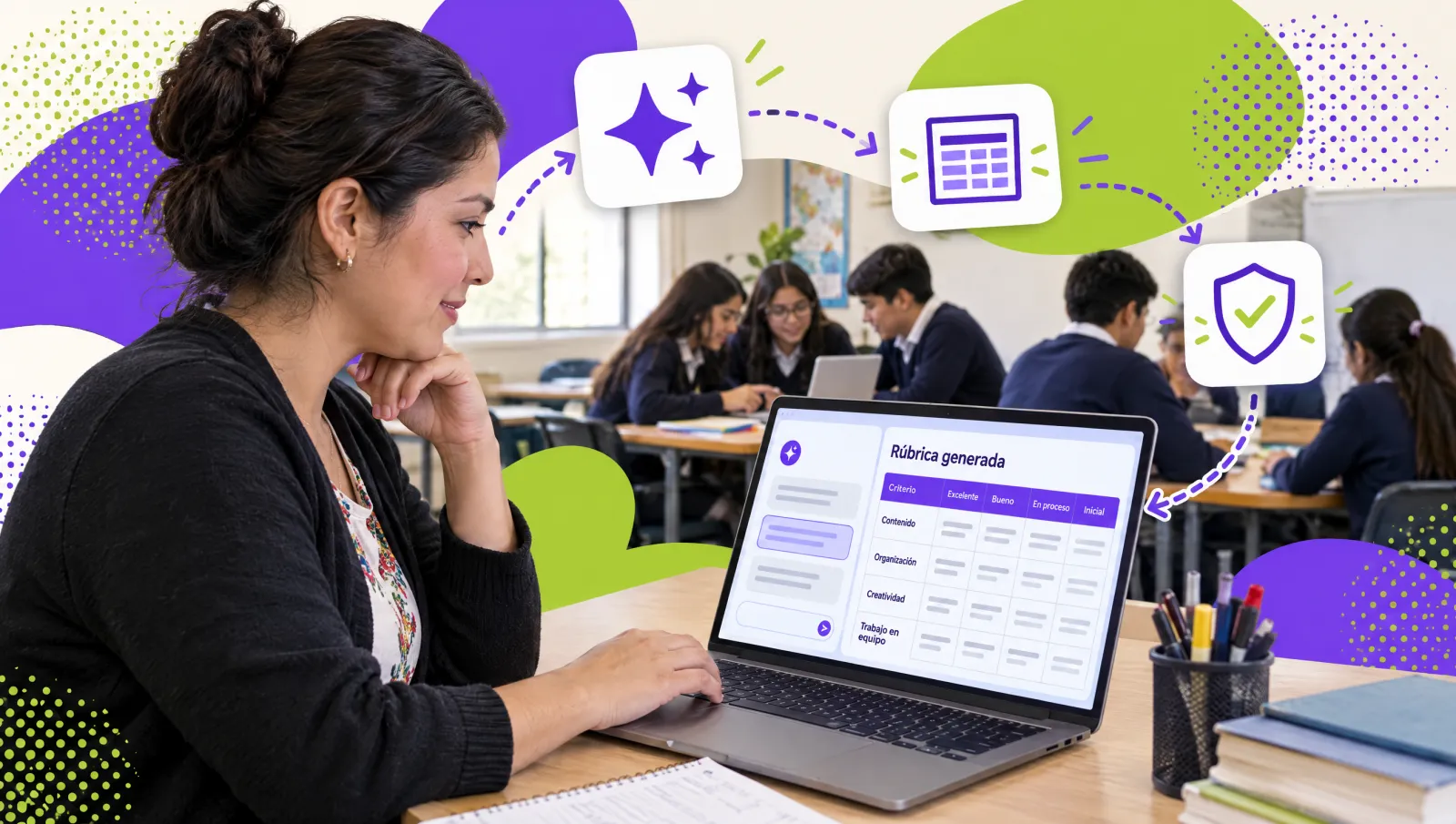
- Rubrics and feedback. Draft rubrics by criterion and level, and first-pass comments on student work that the teacher reviews before returning it.
- Practice and review. Exercise banks, cases, and review questions for students who fell behind, without rebuilding all the materials.
- Course assistants. An agent trained only on the subject’s materials answers questions at any hour and links to the part of the recorded class where the topic was explained.
Example: a middle school lesson planned with AI
A seventh-grade science teacher wants to work on water in her community. This is how she uses AI, step by step, without giving up her judgment:
- Context first. She describes her class (35 students, a neighborhood with frequent water outages, little connectivity at home) and asks for three community project ideas.
- Select and adjust. She picks measuring household water use for a week and drops anything that needs materials she does not have.
- Differentiated materials. She asks for a reading on the water cycle at two difficulty levels and checks it against the textbook.
- Rubric. She generates a draft with four criteria, changes two that do not reflect what she wants to assess, and shares it with her department.
- Authentic closure. Teams present their real data and propose an action for their school: something no chatbot can do for them.
Assessments AI cannot do for the student
If an assignment can be solved by copying a chatbot’s answer, the problem is the assignment’s design. Authentic assessments work better: community-linked projects, products with a visible process (drafts, logs), presentations and oral defenses, analysis of the class’s own data, and reflections on personal experience. Explicitly asking students to use AI and critique its answer also helps.
Ethical, safe use: minimum rules
- Do not upload students’ personal data or grades to public tools.
- Verify every fact, quote, or reference AI produces before using it in class.
- Be transparent when a material or piece of feedback relied on AI.
- Agree with the class which uses are allowed in each activity and which are not.
- Mind equity: not every student has the same access to tools and connectivity.
How to train the whole faculty, not just the enthusiasts
| Phase | What the teacher does | Evidence |
|---|---|---|
| 1. Assessment | Self-assesses digital skills and questions about AI | Starting level |
| 2. First uses | Plans a lesson and creates a material with AI | Adjusted lesson plan |
| 3. Assessment design | Redesigns an assignment so AI cannot solve it | Authentic assignment |
| 4. Feedback | Uses a generated rubric and corrects it | Applied rubric |
| 5. Community | Shares what worked with peers | School-wide good practices |
The key is for each phase to be short, hands-on, and done with the teacher’s real subject. With challenges, levels, and incentives, the faculty progresses at its own pace and the most skilled become mentors. That is how our AI training for teachers works, and it includes Geedle Bot as an AI agent that supports each teacher between sessions. In Monterrey, Guadalajara, and Mexico City it is the topic we are asked for most; see teacher training in Monterrey.